by Rosie Pritchard, Account Manager @ Obsurvant
The 2024 UK general election saw Labour win a landslide majority, winning 411 seats in the house and ending 14 years of conservative rule. With Labour gaining 209 seats, the Conservatives losing 244 seats, as well as the rise of Reform, we wanted to understand the mood of the public around the results and key parliamentary figures.
Between the 14th – 16th July 2024, we conducted an online survey that was taken by a total of 2,203 people. All respondents were incentivised, and each provided opt-in consent in line with MRS and GDPR guidelines.
32% of respondents feel hopeful about the election results.
When asked to pick how they were feeling about the results of the election, 32% of people picked hopeful, 21% choose relieved and 20% selected happy. However, 21% stated they were disappointed and when looking into demographic differences, we saw that people over the age of 65 years (20%), conservative voters (23%) and reform voters (35%) were more likely to pick frustrated than the total sample (14%).
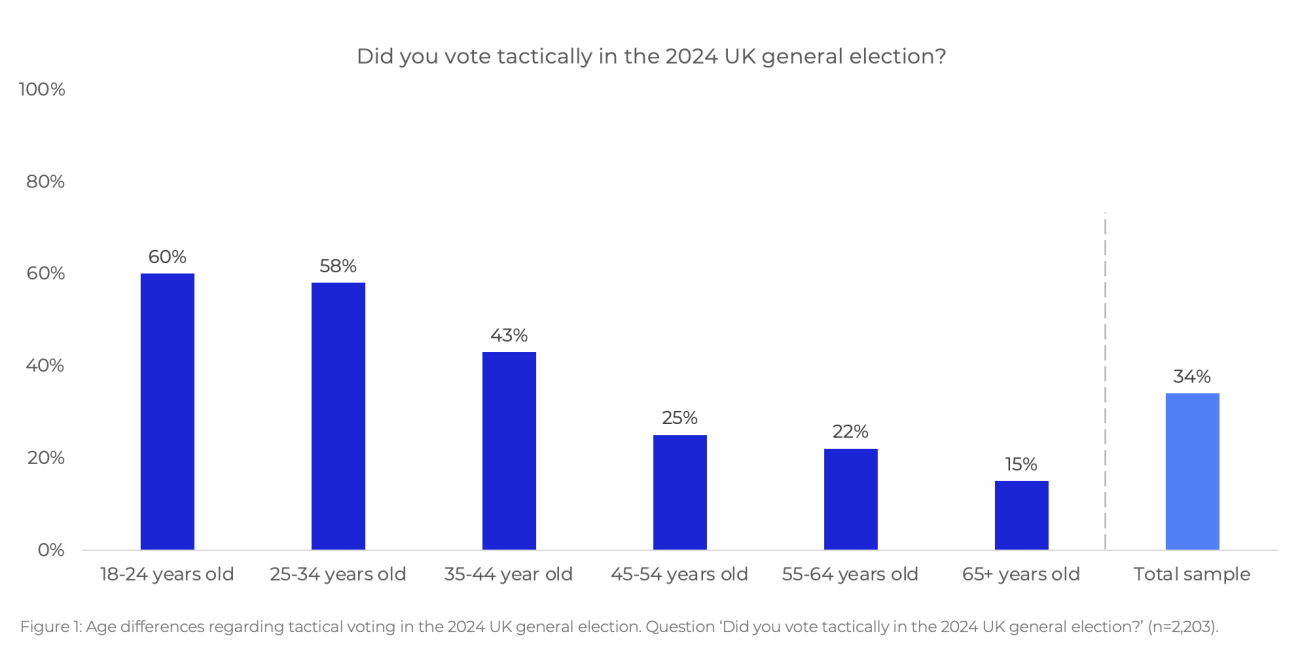
34% of people surveyed stated that they had voted tactically, and only 6% didn’t know what tactical voting was. Younger respondents were also more likely to have voted tactically (figure 1). Respondents who voted tactically were more likely to have voted for Labour (41%) or the Liberal Democrats (43%) than the conservatives (27%).
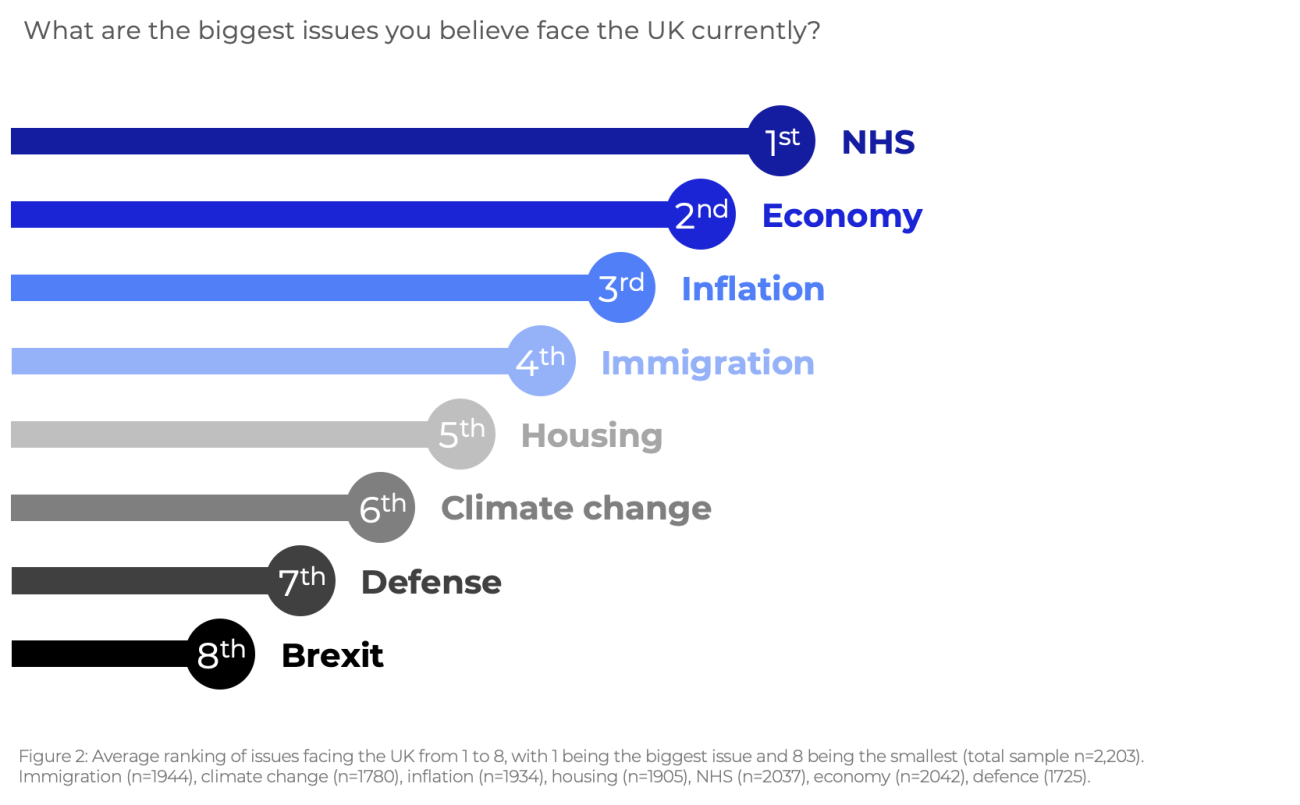
The NHS was rated as the biggest problem faced by the UK in 2024.
We asked people to rate the biggest issues that the UK currently faces; the NHS, the economy and immigration, were picked as the three top issues by respondents (see figure 2). Women were more likely to pick the NHS as the top issue than men (33% vs 25%, respectively). Whereas men (23%) and respondents over the age of 55 (24%) were more likely to rank immigration as the biggest issue. 52% of reform voters believe that immigration is the top issue faced by the UK.
Out of the list given to respondents, defence and Brexit were picked as the smallest issues. However, people living in London were more likely to have ranked Brexit in 1st place (9% of Londoners) or 2nd place (10% of Londoners). And respondents that voted Green were more likely to have put climate change as the top issue affecting the UK, with 29% of Green voters ranking it in first place.
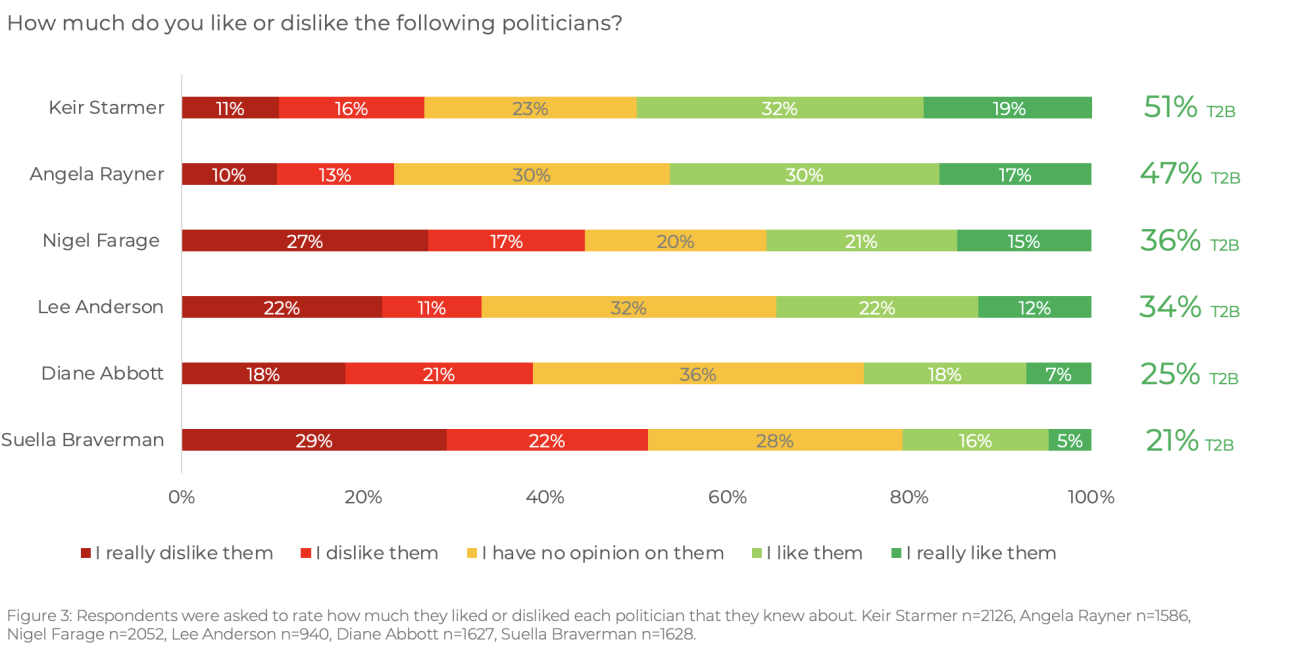
51% of respondents liked Keir Starmer
We asked respondents about their knowledge of politicians, overall, the awareness for the MPs included was high, with Keir Starmer and Nigel Farage being known by the most respondents. The least well-known politician was Lee Anderson, with less than half of respondents knowing who he is.
Respondents were asked if they liked or disliked each of the politicians they knew (see figure 3). 51% of respondents who knew Keir Starmer liked or really liked him, followed by 47% of people who stated that they liked or really liked Angela Rayner. Nigel Farage was the most divisive politician with 44% of respondents stating they disliked or really disliked him, versus 36% who liked or really liked him. Suella Braverman was the most disliked politician, with 51% of people asked disliking or really disliking her, and 21% liking or really liking her.
Respondents see the new Labour Prime Minister as competent, principled but also boring.
People were then provided with an extensive list of positive and negative words that could be attributed to each politician and were asked to pick the top three that best described them. Out of the sixteen attributes given we have reported on the top five attributes for each politician below and pulled out interesting demographic differences.
Keir Starmer
- Competent – 28%
- Trustworthy – 23%
- Principled – 23%
- Boring – 21%
- Likeable – 21%
Significantly more men selected boring to describe Keir Starmer than women (24% vs 19%). Reform and conservative voters were more likely to pick negative attributes than other voters. Whereas, unsurprisingly, more Labour voters picked positive attributes. People who voted for the Green Party were more likely to pick evil (8% vs 2%), dishonest (27% vs 12%) and corrupt (18% vs 7%) than the total sample.
Nigel Farage
- Bigoted – 31%
- Dishonest – 23%
- Likeable – 19%
- Charismatic – 19%
- Corrupt – 17%
Gender differences were also seen for attributes used to describe Nigel Farage. Men picked words such as charismatic (19% vs 13%), principled (15% vs 11%), eloquent (10% vs 7%), trustworthy (13% vs 8%) in comparison to women. Whereas more women picked out of touch (16% vs 10%) and incompetent (15% vs 9%) versus men. Unsurprisingly, Reform voters overwhelmingly selected positive attributes.
Diane Abbott
- Incompetent – 27%
- Out of touch – 24%
- Principled – 15%
- Boring – 13%
- Likeable / Down to earth – 12%
Looking at demographic differences we saw that men were more likely to select negative words to describe her than women; out of touch 28% vs 20%; evil 5% vs 2%; incompetent 32% vs 22%; bigoted 15% vs 8% selected by men and women respectively. Respondents from London picked more positive attributes than the total sample, specifically down to earth (17%), compassionate (15%), principled (25%), competent (16%), eloquent (9%), and trustworthy (16%).
Angela Rayner
- Down to earth – 35%
- Likeable – 25%
- Competent – 21%
- Trustworthy – 19%
- Principled – 18%
We also saw large gender disparities when respondents described Angela Rayner. Men selected more negative attributes than women, namely, out of touch (13% vs 9%), dishonest (17% vs 11%), incompetent (16% vs 9%) and corrupt (12% vs 7%). 40% of women believe she is down to earth versus only 29% of men. Reform voters overwhelmingly picked negative words to describe her, as did conservative voters. Whereas Labour voters were very positive.
Suella Braverman
- Out of touch – 23%
- Incompetent – 22%
- Bigoted – 19%
- Evil – 18%
- Dishonest – 18%
Reform and conservative voters picked more positive attributes to describe Suella Braverman than the total sample. Men also selected more positive words versus women; down to earth 8% vs 4%, principled 15% vs 9%, competent 14% vs 8%, and trustworthy 10% vs 6% of men and women respectively.
Lee Anderson
- Bigoted – 20%
- Dishonest – 16%
- Likeable – 16%
- Down to earth – 15%
- Out of touch – 15%
In comparison to the total sample, Reform voters selected more positive attributes to describe Lee Anderson. 41% of Reform voters selected down to earth vs 15% of the total sample, they also selected likable (23% vs 16%), competent (31% vs 13%), principled (27% vs 14%), and trustworthy (22% vs 13%).
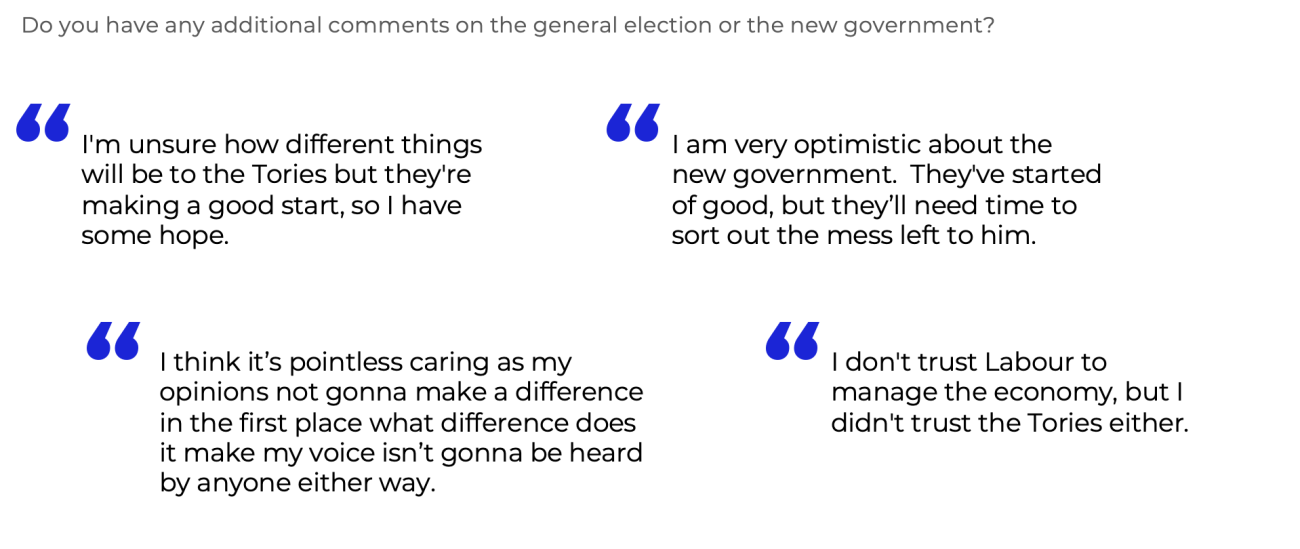
Overall, the mood of people surveyed seemed positive if somewhat dubious. The opens ended responses told a similar story with people hoping for better but unsure of what Labour can or will achieve. However, trust is low so Labour may have a way to go to bring back the public’s belief in politics.